TL;DR

Get cleaning gear delivered free with Prime
- Fast, free delivery on millions of items
- Prime Video, Amazon Music and more included
- Member-only deals all year
You can clean greener around pets by matching the cleaner to the mess and surface, using a small amount of a suitable product, and choosing reusable tools when practical. “Natural” and “eco-friendly” labels do not guarantee pet safety, so follow product directions, ventilate, and keep pets away until treated areas are dry.
A muddy paw print can cross a clean kitchen floor in seconds, and a pet accident can leave a smell long after the visible spot disappears. You can handle both with less waste and less guesswork when you match the cleaning method to the mess, the surface, and your pet’s habits.
This guide explains how to clean greener when you have pets: what to check on product labels, how to handle urine and everyday dirt, and how to keep pets from licking freshly cleaned areas. “Green” and “natural” are not safety guarantees, so the practical goal is to use only what you need and follow directions that fit your home.
Use mild detergent and water for routine dirt only when the surface allows it; choose a compatible enzyme cleaner for organic pet accidents.
Blot urine before treatment, apply an enzyme cleaner as directed, and give it the full contact time instead of masking odor with fragrance.
Treat “natural,” “plant-based,” and “green” claims as prompts to read ingredients, not as proof that a product is safe for your pet.
Keep pets away from wet treated areas, ventilate as directed, and wait for the surface to dry and the label’s re-entry guidance.
Use washable cloths, paw wipes, litter mats, and throws to reduce disposable supplies and prevent mess from spreading.
How to Clean Greener When You Have Pets
Match the cleaner to the mess and surface, use only what the label directs, and keep pets away until treated areas are dry.
Match the mess to the method
The right cleaner can remove residue without adding unnecessary product.
Keep it mild
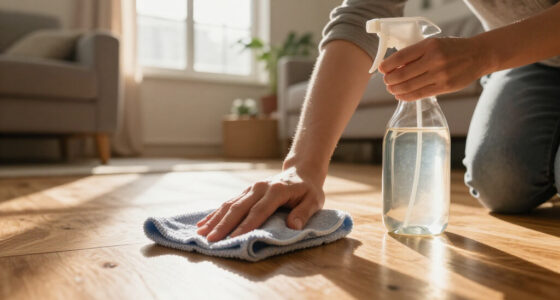
A small amount of mild, fragrance-free detergent and water may handle paw dirt on a compatible surface.
Blot, then treat
Blot urine, vomit, or feces, then use a compatible enzyme cleaner as directed and allow its full contact time.
Clean an accident in sequence
Follow these steps to remove residue without layering products.
Remove the mess and blot the area; avoid scrubbing fresh urine deeper into carpet.
Confirm the cleaner suits the material and follow test-spot and application directions.
Apply the recommended amount, allow the stated contact time, and keep pets away while it works and dries.
Launder accident-cleanup cloths promptly and separately from food-contact items.
Read the label, protect your pet
“Natural,” “plant-based,” and “green” claims do not guarantee safety for every animal.
- Read ingredients and product directions.
- Use one cleaner at a time; never mix products.
- Take extra care with tea tree, pine, citrus, and eucalyptus oils.
- Ventilate as directed.
- Wait until the surface is fully dry and the label permits re-entry.
- Ask a veterinarian about individual health or exposure concerns.
Prevent mess and reduce waste
Small household habits can limit both cleanup and disposable supplies.
Start with the mess, not the green label
To clean greener when you have pets, choose a product for the specific mess and surface, then use the smallest amount that its directions call for. A little mild, fragrance-free detergent and water may handle ordinary paw dirt on a compatible sealed floor, while an enzyme cleaner can help break down organic residue from urine, vomit, or feces.
That distinction saves effort as well as product. If your dog tracks a few dusty paw marks across tile after a walk, you probably do not need a disinfectant or a scented spray; a damp washable cloth may do the job. A urine spot on carpet is different: wiping only the visible mark can leave odor-causing residue behind.
Match the product to the material before you start. A cleaner suitable for sealed tile may be unsuitable for unfinished wood, some carpets, or natural stone. Test according to the product and surface manufacturer’s instructions in an inconspicuous place, especially if you are cleaning a favorite rug or a delicate floor.
For an accident, blot up what you can first, then apply a compatible enzyme cleaner as directed. Use the recommended amount and let it sit for the stated contact time; rushing the step can leave the odor source behind. Clean the residue before trying to mask its smell.
Products Worth Considering

eufy E25 Robot Vacuum and Mop for Pet Hair, 20,000 Pa, HydroJet Roller Mop

Levoit Vital 100S-P Air Purifier with Washable Pre-Filter

eufy Security SoloCam S340 3K Dual-Lens Solar Security Camera
As an affiliate, we earn on qualifying purchases.
Read the label before letting your pet back in
A “green,” “plant-based,” or “natural” label does not prove that a cleaner is safe for every pet. The actual ingredients, concentration, how your animal might contact them, and the product directions all matter. Check the label, use the product only as directed, ventilate the room, and keep pets away from wet treated surfaces.
Essential oils deserve special care. Tea tree, pine, citrus, eucalyptus, and other oils can be hazardous to pets, particularly when concentrated or swallowed; cats can be especially sensitive to some compounds. A citrus scent in a cleaner may smell fresh to you, but that does not make it appropriate for a cat that walks across the floor and grooms its paws.
Consider your own animal’s habits as well as the ingredient list. If your puppy licks every damp patch, or your cat sleeps beside a recently treated rug, take extra care about access and drying. Pets with asthma, allergies, or skin conditions may need individual guidance from a veterinarian.
Keep pets away during cleaning and until the product label permits their return. Let treated surfaces dry fully, ventilate as directed, and store concentrates and supplies where curious noses and paws cannot reach them.
Certifications and environmental claims can help describe packaging or ingredient standards, but they do not answer every question about animal exposure. When you are unsure about a particular product or pet, ask your veterinarian rather than relying on the front of the bottle.
Use this simple sequence for urine, vomit, and feces
For a pet accident, remove the mess, blot the area, and use a surface-compatible cleaner according to its label. This sequence reduces the residue left behind without adding fragrance or extra products. For example, if your cat urinates on a washable rug, start by lifting the rug if its care instructions allow it and blotting the spot with a clean cloth.
- Pick up or blot the mess. Use disposable material or a washable cloth, depending on the mess and your cleanup routine. Avoid scrubbing fresh urine deeper into carpet fibers.
- Check the material and cleaner directions. Confirm that the cleaner is suitable for the surface, and follow any dilution, application, and test-spot instructions.
- Apply the cleaner as directed. An enzyme product may need enough coverage and a set contact time to work on organic residue. Do not add a second cleaner on top.
- Keep pets away while it works and dries. Ventilate the area as directed and wait until the label’s re-entry guidance is met and the surface is fully dry.
- Wash reusable cloths promptly. Keep them separate from food-contact items and follow their laundering instructions.
Fragrance can make a room smell different without removing the residue that caused the odor. Avoid layering scented products over an accident, and be cautious with heat: it can make some stains harder to remove. If a stain or smell remains, check the cleaner and surface-care instructions before repeating the treatment.
Choose reusable tools that make less laundry work
Washable cloths and mop pads can cut down on disposable waste when you use them for ordinary cleaning and launder them promptly after pet accidents. A small set of cloths near the entry and a separate mop pad for floors can handle muddy paws without reaching for a fresh paper towel every time. Reusable does not mean ready to reuse immediately: clean tools before they touch another area.
For instance, if your spaniel comes in from a wet park with sandy paws, you can wipe its feet with a damp cloth at the door and clean the tile with a washable mop pad. That routine can help keep grit from scratching or spreading across the floor. Check the floor maker’s care advice before adding water or detergent, particularly for wood.
- Keep cloths used for pet messes apart from kitchen and food-contact cleaning cloths.
- Launder accident-cleanup materials promptly, following fabric-care directions.
- Store clean tools dry so they are ready for the next paw print.
Reusable supplies still use water and energy when washed, so there is no need to create a separate load for every small mark if the cloth can be safely stored until laundry time. The useful change is a practical system: a washable tool for routine dirt, prompt laundering for accident cleanup, and fewer single-use wipes for jobs a cloth can handle.
Prevent paw prints and repeat accidents at the source
Preventing messes is one of the simplest ways to use less cleaner: remove dirt before it spreads, and you have less to scrub later. A washable throw on the sofa, a litter mat near the box, and a towel by the door can catch mess at its starting point. These small habits often matter more than adding another bottle to the cupboard.
Imagine a rainy evening: your terrier barrels in with wet paws, then races toward the couch. If a towel is already by the door, a quick paw wipe keeps muddy water off the rug and upholstery. If the towel is buried in a laundry basket upstairs, you may end up cleaning a larger patch with more product.
Grooming and routine care can also reduce loose fur and tracked-in dirt. Brush where cleanup is easy, and use a washable throw on a pet’s favorite spot if the fabric and pet tolerate it. For a litter area, a mat can catch stray granules before they reach the hallway; empty it and clean it according to its care directions.
Prevention will not stop every accident, and pets do not follow a house-cleaning schedule. Still, a ready towel, a suitable cleaner stored safely, and an easy-to-wash cover can reduce how much cleaner you need. Small routines work best when you can keep them up on a busy day.
Keep common DIY cleaners in their lane
DIY ingredients can help with limited tasks, but none is a universal cleaner for every pet mess and surface. Diluted vinegar may suit some routine cleaning jobs when the surface maker allows it; it is not a dependable substitute for an enzyme cleaner on urine, and it can damage certain materials. Baking soda may absorb some odors, but pets should not lick or swallow the powder.
Consider a cat accident on a stone floor. Reaching for vinegar because it is in the pantry may damage a surface that needs specific care, while using a suitable product recommended for that material gives you a safer starting point. A kitchen ingredient is still a chemical with limits, even if the package looks familiar.
| Option | May help with | Watch for |
|---|---|---|
| Mild detergent and water | Routine dirt on compatible surfaces | Use a small amount and follow surface guidance. |
| Enzyme cleaner | Organic pet residue and odor | Check surface compatibility and allow the labeled contact time. |
| Diluted vinegar | Some routine cleaning tasks | Not a universal disinfectant; avoid on surfaces it can harm. |
| Baking soda | Some limited odor absorption | Keep it away from pets that may lick or swallow it. |
Never mix cleaners. Bleach mixed with ammonia or acids such as vinegar can release dangerous gases. Use one product at a time, follow its label, and keep pets out while you clean and ventilate.
Know when cleaning is enough and when disinfection matters
Cleaning removes visible dirt and residue; disinfection is a separate step that uses a product labeled for that purpose. You do not need to disinfect every muddy paw print or routine litter scatter. For everyday mess, removing the soil with a suitable cleaner may be enough, while an illness or other specific concern may call for guidance from a veterinarian and an appropriately labeled disinfectant.
If disinfection is needed, choose a product labeled for the intended surface and follow its instructions for dilution, contact time, ventilation, and pet re-entry. A quick spray and wipe may not meet the product’s stated contact time. For example, if a label says a surface must remain wet for a set period, wiping it dry early can prevent the product from working as directed.
Never assume that a cleaner is also a disinfectant, or that a disinfectant is safe for a pet to lick once wet. Keep the animal away through the full process and until the directions allow access. If your pet has a health condition or you need to disinfect an area it will contact often, a veterinarian can help you consider the right precautions.
This approach also avoids unnecessary chemical use. When a dog drags garden soil across a washable mat, cleaning the dirt is a different job from disinfecting a surface after a health risk. Match the step to the reason, then stop when the surface is clean and the label’s directions are satisfied.
Frequently Asked Questions
Are natural or green cleaners safe around pets?
Not automatically. Safety depends on the ingredients, concentration, how your pet might be exposed, and the product directions. Read the label, ventilate as directed, and keep your pet away from wet treated surfaces until it is safe to return.
Are essential oils safe for dogs and cats?
Some essential oils can harm pets, especially when concentrated, swallowed, or spilled on fur or skin. Cats can be especially sensitive to some compounds. Do not apply oils to pets or use them where animals can contact them unless a veterinarian has advised it.
What is the best way to clean pet urine?
Blot up as much as possible, then use a surface-compatible enzyme cleaner according to its label. Allow the recommended contact time and avoid covering the odor with fragrance before removing the residue. Heat can make some stains harder to remove.
Can I use vinegar to clean pet messes?
Diluted vinegar may work for some routine cleaning on compatible surfaces, but it is not a universal disinfectant or a reliable replacement for an enzyme cleaner on urine. It can damage some materials. Never mix vinegar with bleach.
How long should pets stay off a cleaned floor?
Follow the product label’s re-entry directions. As a general precaution, keep pets away until the surface is fully dry and the room has been ventilated as directed, since pets may walk across or lick treated areas.
What should I do if my pet licks or spills a cleaner?
Move your pet away from the cleaner and contact a veterinarian or animal poison-control service promptly. Keep the container or ingredient list nearby so you can share the product details. Do not induce vomiting unless a professional tells you to.
Conclusion
When you clean around pets, use the least complicated method that suits the mess and the surface. Blot accidents, follow a compatible cleaner’s directions, keep pets away while the area dries, and set out reusable tools where messes start.
A towel by the door can do more for a muddy floor than another scented bottle. Keep the towel ready, and let the paw prints stop there.