TL;DR

Get cleaning gear delivered free with Prime
- Fast, free delivery on millions of items
- Prime Video, Amazon Music and more included
- Member-only deals all year
Hunker published a roundup of 16 ways to reuse concrete blocks around the home and garden, including planters, tables, privacy walls and water features. The article includes construction suggestions for some projects and advises checking local regulations for a pool. It provides no cost estimates.
Hunker’s report, “16 Ways To Transform Concrete Blocks Into Home & Garden Treasures,” describes ways to reuse the masonry units in household and garden projects, from planters and tables to stairs, walls and fountains. The article offers suggestions for using leftover or reclaimed blocks, including construction guidance for some projects and a reminder to check local regulations for a pool.
The roundup describes concrete blocks as having a regular shape and durability that can make them easy to repurpose. Its suggestions include using blocks as a TV stand, side table or nightstand, with wood or stone across the top and shelves placed through openings. For tables, the report says to align the supports and use adhesive to keep the tabletop from sliding; it says mortar may be appropriate for a permanent table.
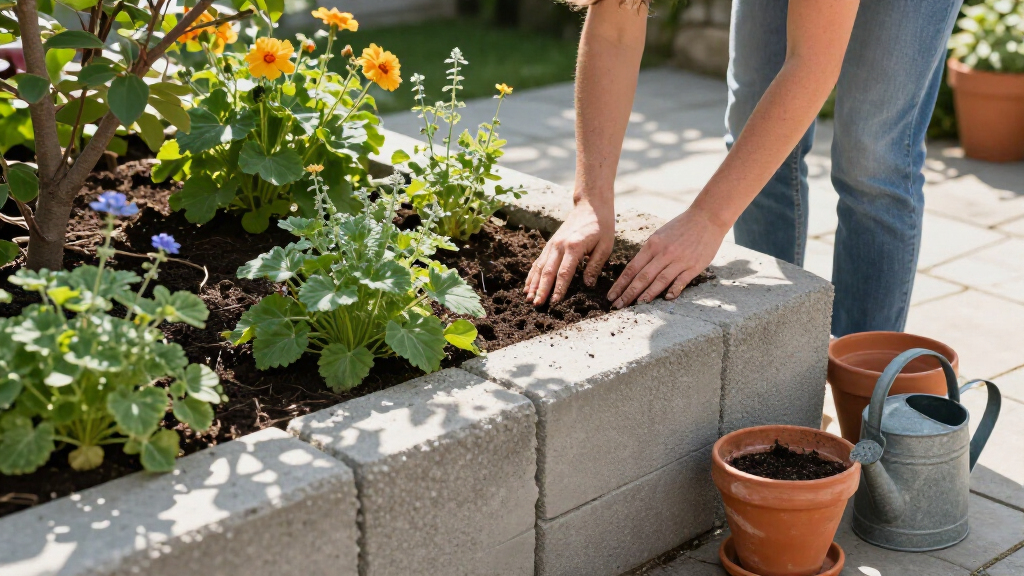
For gardens, the report says the openings can hold small plants and describes stacking blocks into a plant tower, pyramid or wall. It recommends adding mesh or landscape fabric to the bottom of the holes to keep soil and plants from falling through. Other decorative ideas include painting blocks as seasonal figures or arranging them into sculptural forms. For a fountain, the report says to waterproof the blocks to prevent leaks.
The more demanding proposals include stairs, privacy walls and small pools. For permanent outdoor stairs, the article recommends a firmer base and filling gaps with sand or cement. It says properly assembled concrete-block walls with rebar reinforcements and a waterproof coating can form the basis of a small pool, and advises checking local rules for permits. These are broad project concepts, not complete construction specifications.
From Leftover Blocks to Useful Projects
For readers with spare building materials, the list presents ways to reuse concrete blocks in furniture and garden projects. Examples include arranging blocks to support surfaces or create planting spaces. The report also discusses stability for tables and advises paying attention to damage when considering blocks for reuse.
The article gives different suggestions for projects such as planters, stairs, walls and pools. It recommends a firmer base and filled gaps for permanent outdoor stairs and says to check local regulations before starting a pool project. The roundup provides ideas and some construction guidance, but does not give complete specifications for every project.
As an affiliate, we earn on qualifying purchases.
What the Guide Recommends
The source material says concrete blocks are often relatively inexpensive and may be available as leftovers or reclaimed materials. It also notes that the terms “concrete block” and “cinder block” are sometimes used interchangeably, while saying cinder blocks should be watched for damage. The article does not provide a detailed identification guide or testing method.
The report offers examples involving paint, fabric, wood or stone, as well as blocks used as supports, containers or building units. The supplied material describes ideas including a staircase, planter, television stand, pool, table, privacy wall, art, fountain, nightstand, outdoor kitchen, bookshelf, garden bench and raised garden bed. It does not provide step-by-step plans for each idea.
““Concrete blocks are generally easy to repurpose, since they have a regular shape and excellent durability.””
— Hunker report
As an affiliate, we earn on qualifying purchases.
Plans, Costs and Safety Details
The supplied material does not state when the roundup was published, provide project costs, or report on completed builds. It also does not give measurements, load limits, detailed foundation specifications or comprehensive instructions for the more complex ideas. Readers cannot determine from the article alone whether a particular block is sound enough for a planned use.
Permit rules and building requirements depend on location and project details. The report advises checking local regulations for a pool but does not establish whether a permit is required in any specific jurisdiction. The feasibility of permanent stairs, walls, pools and fountains likewise depends on site conditions and construction methods that the roundup does not assess.
As an affiliate, we earn on qualifying purchases.
Check Before Building
Readers interested in a project should first inspect the blocks and decide whether the intended use is decorative or structural. For permanent construction or features that hold water, they should consult local building requirements and qualified professionals before work begins. The source offers no follow-up schedule or announced next development; practical next steps depend on the project and location.
waterproof concrete blocks for fountain
As an affiliate, we earn on qualifying purchases.
As an affiliate, we earn on qualifying purchases.
Key Questions
What projects does the Hunker report suggest?
The supplied material describes uses including planters, tables, a TV stand, a nightstand, stairs, privacy walls, art, fountains and pools. The source title promises 16 ideas, but the provided excerpt does not detail every one.
Can concrete blocks be used as planters?
The report says their openings can hold small plants and suggests adding mesh or landscape fabric at the bottom to keep soil from falling through. It also describes stacking blocks into larger planting arrangements.
Are stacked blocks suitable for permanent stairs or walls?
The article outlines ways to build these features but does not provide full construction plans. Permanent stairs and walls require attention to the base, stability and local requirements; the roundup alone cannot establish that a particular design is safe.
Do concrete-block pools require permits?
Permit requirements vary by location. Hunker advises checking local regulations before starting a pool, but the supplied report does not say which permits apply in any specific area.
Can reclaimed or cinder blocks be reused?
The report says reclaimed blocks may be available and notes that many blocks called cinder blocks are concrete blocks, while also warning that types can differ. It recommends paying attention to damage; it does not provide a formal inspection standard.
Source: rss
Halloween Picks
halloween
As an affiliate, we earn on qualifying purchases.