
TL;DR

Get cleaning gear delivered free with Prime
- Fast, free delivery on millions of items
- Prime Video, Amazon Music and more included
- Member-only deals all year
A Hunker home-improvement report describes using a razor scraper to remove paint from French-door glass after painting, rather than taping around every pane. It advises waiting until the paint is dry but generally no more than 24 hours, and scraping gently to reduce the risk of scratching or cracking the glass.
Hunker has outlined a way to paint French doors without first taping every glass pane: paint the doors, let any stray paint dry, then remove it from the glass with a sharp razor scraper. The report describes this as a quicker approach than using painter’s tape and advises careful handling to avoid damaging the glass.
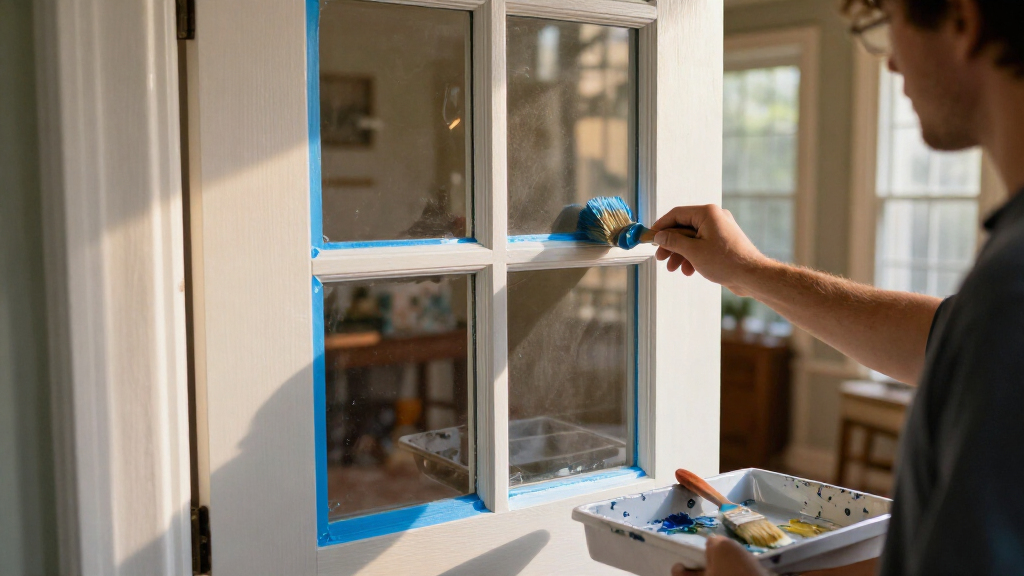
French doors often have narrow bars, or muntins, that separate the glass into smaller panes. Painting those bars neatly can be difficult, and Hunker says slips may leave paint on the glass even when someone tries to cut in carefully with a brush. Painter’s tape is a common way to protect the panes, but applying it around many edges takes time, and paint can seep beneath it.
The alternative described in the report is to scrape unwanted paint off once it has dried. Hunker says most house paints and primers do not adhere strongly to smooth glass, making dried spots relatively easy to lift. It recommends doing the cleanup while the paint is dry but not left too long—typically within 24 hours—because paint can become harder to remove as it dries further.
For the technique, the report advises holding a sharp razor scraper at a 45-degree angle or shallower and gently pushing it against the paint. The blade should be directed at the paint, not pressed down into the glass. Once an edge lifts, the paint can be pulled away by hand or scraped further; at the muntin, the report says to carefully slice along the edge for a cleaner finish. It recommends cleaning the glass afterward to remove any haze.
Less Masking, Careful Cleanup
For homeowners painting doors with many small panes, the method shifts work from preparing every glass edge to cleaning the glass after painting. Hunker describes the razor-scraper approach as quicker than applying painter’s tape. It also offers an option for people who find it difficult to keep a brush precisely on the wood.
The report warns that a dull blade makes removal harder and that scraping carelessly can damage the glass. It advises using a sharp blade and gently scraping without pressing down into the glass.
Products Worth Considering

Dyson W1 PencilWash Cordless Wet and Dry Floor Cleaner with Dock

Bose SoundLink Flex Bluetooth Speaker (2nd Gen), Waterproof, Dustproof, USB‑C, Up to 12 hr Battery, Black

Shark HydroVac MessMaster Corded Wet Dry Vacuum and Mop (WD161)
As an affiliate, we earn on qualifying purchases.
Why Tape Is Not the Only Option
The report frames the issue around the geometry of French doors: each muntin creates another glass-to-wood boundary to protect while painting. Tape can cover those boundaries, but it must be applied closely and may not prevent all seepage. Hunker also mentions liquid masking products as another option, while noting that liquid masking tape can potentially damage the window’s wooden frame and may still need to be cut away with a blade.
Hunker names a two-piece Titan razor scraper set as one possible tool and cites a Goldblatt scraper with a four-inch blade as an option for larger panes. These are product examples in the report, not a requirement for the method. The source discloses that it may receive commissions from purchases made through links, a relevant consideration when reading its product recommendations.
““Most types of house paints and primers don’t adhere well to smooth glass.””
— Hunker report
Results Depend on Paint and Glass
The report does not identify which paint formulations might respond differently to scraping. It also does not provide independent testing comparing the time, cost or damage risk of scraping with painter’s tape or liquid masking. Its advice that paint is usually easier to remove within 24 hours is a general guideline, not a guarantee for every product or condition.
Hunker warns that scraping can damage glass if done carelessly and that a dull blade can make removal harder. The report advises careful scraping and not pressing down into the glass.
Check the Paint Before Scraping
Hunker’s described sequence is to paint the doors, allow stray paint to dry without waiting too long, then gently scrape it from the glass and work carefully toward the muntin edges. A final glass cleaning can remove leftover haze.
The Hunker report does not announce a product launch or a broader change in painting guidance; it offers a household technique. Whether it saves time on a particular project will depend on the number and size of the panes, the paint and the user’s comfort with a razor scraper.
Key Questions
What is the alternative to painter’s tape?
Paint the door, then scrape stray paint from the glass with a sharp razor scraper after it dries, following the tool’s safety instructions.
When should the paint be scraped off?
Hunker recommends scraping once the paint is dry, usually within 24 hours. It says paint may become more difficult to remove if left longer; the timing can vary.
How should the scraper be held?
The report advises using a 45-degree angle or shallower and gently working against the paint. Do not press the blade down into the glass.
Can scraping damage French-door glass?
Yes. Hunker warns that careless scraping can scratch or crack glass, and that a dull blade can make the task harder. Use caution and do not force the scraper.
Does the method work with every paint or pane?
The source says most house paints and primers do not adhere strongly to smooth glass, but it does not establish that scraping works safely on every paint formulation, glass coating or door.
Source: hunker.com