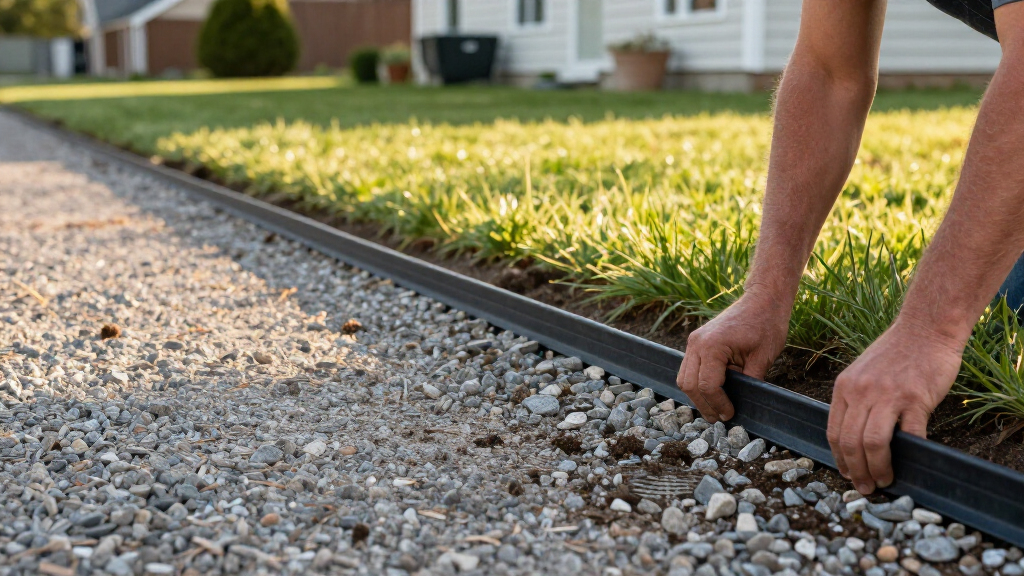
Granite is a natural igneous rock used in landscaping and building materials. Hunker cites its density and low porosity, along with its ability to tolerate heat, as qualities that make it suitable for outdoor edging. The report says a properly installed border can hold gravel in place and create a physical boundary between the driveway and adjoining lawn. Hunker also presents edging as a way to help limit grass runners.

Get cleaning gear delivered free with Prime
- Fast, free delivery on millions of items
- Prime Video, Amazon Music and more included
- Member-only deals all year
The report recommends setting edging 4 to 6 inches into the soil and leaving about 2 inches above ground. Hunker says this arrangement is intended to obstruct underground runners while forming a visible barrier against surface growth. It gives a 10-by-7-by-4-inch cobblestone as an example that would need to be placed vertically to reach the suggested depth and height.
For a straight driveway, Hunker says granite curbing offers clean lines for seamless alignment. The report says curbing pieces are often sold in four-foot lengths, while individual granite cobblestones, also called Belgian blocks, can suit varied shapes and create a more traditional appearance. Granite boulders are another possibility, though their size can make them difficult to move. The report also notes that granite comes in colors including white, dark gray and red.
Why It Matters
Grass spreading into gravel can make a driveway harder to maintain and blur the boundary between the driving surface and the lawn. Hunker presents a fixed granite border as a way to help keep aggregate in place and make the edge easier to distinguish. The report recommends proper installation for the edging to help keep grass out. It also discusses regular weeding and gravel replenishment for growth within the gravel.
The material choice also affects the appearance of the frontage. Hunker says granite’s natural patterns can create definition between gravel and grass and notes that granite is available in a range of colors. The report describes straight curbing as offering clean lines for alignment, cobblestones as suitable for varied shapes, and boulders as potentially difficult to move depending on their size.
Hunker says all types of edging help prevent erosion by framing the driveway and helping contain its gravel. The report does not quantify that effect or compare granite with other edging materials.
Products Worth Considering

Ring Battery Doorbell Plus (2nd Gen) and Indoor Cam Plus Bundle, Nickel Silver and White

Bose SoundLink Flex Bluetooth Speaker (2nd Gen), Portable Waterproof Speaker, Black

Ring Battery Doorbell and Chime (3rd Gen), Satin Nickel
As an affiliate, we earn on qualifying purchases.
Background
The Hunker report frames the problem as two related maintenance issues: weeds growing up through gravel and grass advancing from the lawn. It says growth within the gravel can be addressed through regular weeding and gravel replenishment, while lawn encroachment may be more difficult depending on how much of the driveway borders grass. Edging is presented specifically as a way to define that boundary and limit spread from the lawn.
Hunker recommends considering the driveway’s length and shape when choosing granite edging. It describes curbing as an option for a straight driveway and says individual cobblestones can fit many driveway shapes. Boulders may also be an option; the report says that in places such as New Hampshire, where granite is abundant, homeowners may be able to source them for free from their property. Hunker uses a 20-foot driveway bordered by lawn on both sides to illustrate its curbing estimate: five four-foot pieces on each side, or 10 pieces total.
The report identifies granite as a material used for outdoor landscaping as well as indoor tiles and countertops.
What Remains Unclear
Hunker recommends installing granite edging 4 to 6 inches into the soil and leaving about 2 inches above ground. It provides a 10-by-7-by-4-inch cobblestone as an example of a unit that would need to be placed vertically to reach the suggested depth and height.
The report also says growth within gravel can be addressed through regular weeding and gravel replenishment. It does not discuss installation costs, drainage or grading changes, soil types, or comparisons with other edging materials.
Source: hunker.com